
The Equal Parenting Act
In most family separations, children benefit when they keep meaningful relationships with both parents. South Carolina custody law should reflect this reality.
What Would the Equal Parenting Act Change?

Start with Equal Time
Courts would begin with a rebuttable presumption that approximately equal parenting time is in a child's best interest, unless the evidence supports another arrangement.

Guardian ad Litem Accountability
The legislation would modify rules governing guardian ad litem appointments, conduct, and oversight.
Preserve Judicial Discretion
Judges can still award unequal parenting time based on the child's best interests and relevant circumstances, including domestic violence. Departures from equal time require written findings.

Clearer Custody Decisions
The legislation would address parenting plans, written judicial findings, and circumstances involving interference with parenting time.
Why Family Court Is Broken in South Carolina
The current family court system is optimized to move money from families to lawyers, professional evaluators, and the government. By reducing high-conflict custody cases, equal parenting eliminates financial extraction.

Billable Hours, Not Best Interest
The trial lawyer lobby has crafted a system that maximizes costs to families. Every custody case is designed to have a winner and a loser, forcing desparate parents to spend huge sums of money to stay in their children’s lives. Custody litigation routinely costs six to seven figure over several years. Trial lawyers fight equal parenting because it reduces high-conflict custody cases that drive their profits.

Professional Gatekeeping
Courts have created a layer of “expert class” professionals that control access to children. Judges can order Guardians ad Litem, psychologcal evaluations, and reunification therapy in any case as long as one party’s attorney requests it. Negative appraisal from any one of these evaluators can instantly cut off access to kids. Parents are ordered to pay the bills, allowing one side of litigation to weaponize financial reosurces against the other. In other states, these court-ordered experts are assigned to 10-20% of cases, but in South Carolina they’re required 90% of the time.

Title IV “Kickbacks”
The federal government pays states 66% of their costs to run the child support program, plus bonus incentives based on how much support they collect. This incentivizes courts to push for higher support orders, which require one parent to have far less time with the children. Child support alone has created a criminal court within family court: any parent who doesn’t pay can be sentenced to jail without trial.
Equal Parenting in South Carolina: A Decade of Delay
Some SC legislators are fighting for Equal Parenting, but others are obstructing reform on behalf of the lawyer lobby.
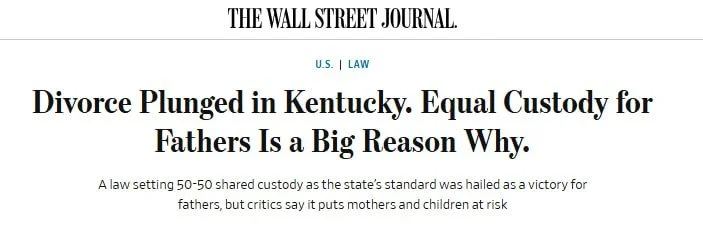
April 2018 | Kentucky Enacts Equal Parenting Reform: Governor Matt Bevin signed HB 528 into law, creating a rebuttable presumption favoring equally shared parenting time, subject to exceptions such as domestic violence. In becoming the first state to pass an equal-time law, Kentucky provides a roadmap for how statewide legislation could pass with broad bipartisan support.

December 2018 | South Carolina's First Equal Parenting Bill — H.3295: SC representative Jason Elliot filed legislation proposing a rebuttable presumption of joint custody and equally shared parenting time. The bill was referred to the House Judiciary Committee in January 2019, where it remained without receiving a vote.
2021-22 | Support Grows — H.3569: Representative Stuart Jones filed a new equal parenting bill in December 2020. Its sponsorship expanded substantially, including legislators from both parties: House Minority Leader J. Todd Rutherford, future Democratic governor candidate Jermaine Johnson, House Majority leader Davey Hiott, and future House Majority leader Micah Caskey. Despite gaining 60 sponsors, the legislation never received a vote in the House Judiciary Committee.
2023-24 | Stuck in Judiciary — H.3481: Equal parenting was re-introduced into the House Judiciary committee. Despite having 60 sponsors, it met the same fate as before: it was never put to a vote. The issue received essentially no coverage in local media.
2024-25 | Grassroots Momentum Builds: Advocacy group Americans For Equal Shared Parenting hosted a training event in Columbia SC on April 30, 2024 as part of a larger effort to engage citizens with legislators on equal parenting. It was the second major conference by AFESP in SC, following one held during the initial grassroots push in 2019.
December 2025 | The Equal Parenting Act — H.4622: House Representatives Gil Gatch and Sarita Edgerton, along with Rom Reddy’s DOGE SC, rolled out the fourth major equal parenting bill in SC called “The Equal Parenting Act.” In addition to establishing a rebuttable presumption of equal custody, the bill added accountability measures for Guardians ad Litem, including drug testing and a requirement that GALs presume equal time is in children’s’ best interest. A joint poll commissioned by the National Parents Organization and DOGE SC found that 80-90% of South Carolina citizens supported equal parenting. Several large media organizations started reporting on the issue, while the legal lobby began openly advocating against the bill.
January-March 2026 | Pushback and Delay: The Equal Parenting Act was put on the agenda of a February 2026 Judiciary committee meeting, but did not receive a vote when House Judiciary leadership prioritized a debate on redistricting. The same month, state Senator Josh Kimbrell introduced a Senate version of the bill. The House version continued to accumulate support, reaching 27 sponsors by the end of the legislative session.
April 2026 | Legal Lobby Resistance: On April 2, 2026, equal parenting received a dedicated hearing that lasted over 4 hours. Two of the five subcommittee members (Donald McCabe and Tiffany Spann-Wilder) did not show up for the hearing at all, and one member (Jerry Govan) was late.
South Carolina Chief Justice John Kittredge opened his testimony against the bill by claiming that parents within the family court system did not bring an “objective perspective” to family court and often had a “skewed view of reality.” Kittredge then argued that a rebuttable presumption of equal time was “contrary to the structure” of family court because it limited judges’ power. Several other legal professionals also testified against the bill, including prominent family attorney James McLaren and Chair of the SC Bar Family Law Council Jennifer Creech. The legal lobby pushed a competing bill backed by Val Guest and Heather Crawford that removed all protections from parents. At the end of the hearing, subcommittee chair Travis Moore resolved to collect more testimony under the nominal justification that not enough committee members were present to hold a vote. The hearing received its largest quantity of media coverage yet, and multiple SC family law firms put out statements in anticipation of the bill’s passage. Despite this momentum, neither Moore nor House Judiciary Chair Weston Newton called for a vote on the act in the 2026 legislative session.
October 2026 | Solutions Conference: Family Court reform advocates from across the country met in Columbia, SC on October 15-17 for a vigil and Voices of Hope conference to mobilize support for family court reform. Sarita Edgerton (R) attended the conference, while Democratic candidate for Governor Jermaine Johnson gave a keynote speech.
Transparency. Accountability. Citizen Participation.
Meaningful family court reform requires an informed and engaged public. We believe South Carolina citizens deserve to know where their elected officials stand—and what actions they take. If you think you can contribute to our strategic priorities in any way, please contact us!