

Family Court is broken in many ways. But perhaps the system’s darkest secret is the way that many legal professionals treat children as a commodity for financial extraction.
The divorce and child custody industry is massive. Estimates start at $44 billion, but the real number is much higher.
Numerous professionals make their living through family court: attorneys, judges, guardians ad litem, and psychologists all profit off family separation. There is also a multi-billion dollar federal program called Title IV-D in which funds state child support collection bureaucracies.
Of course, there’s nothing inherently wrong with professionals practicing their craft to make a living. But problems arise when some of these professional lobbies block fixes to family court in order to maximize their own profitability.
As South Carolina Representative Stewart Jones explained to a South Carolina conference in 2024: “The system is making money off the situation. It’s cash for kids. And that is sick.”
The real problem isn’t any one judge, attorney, or professional evaluator. It’s the way the system puts its own financial needs above the wellbeing of kids, calls it “the best interest of the child”, and then attacks parents who disagree.
The perverse incentives within family court system are a bad enough on their own. But there have also been several instances where family court professionals have been caught red-handed scheming to maximize profits at the expense of children.
Two cases in Missouri illustrate the depths that some professionals will go to profit from family separation. Let’s take a look.

“When you’re selling kids”
In a 2021 St. Louis County lawsuit, mother Evita Tolu alleged that guardian ad litem Elaine Pudlowski, psychologist James Reid, and clinical social worker Jennifer Webbe VanLuven exploited her custody case for financial gain.
Tolu alleged the professionals did so by prolonging litigation, overbilling her tens of thousands of dollars, and producing biased reports that alienated her children.
The complaint described a pattern in which court-appointed professionals treat children primarily as a revenue stream. The same accusation has been made my many parents in family court. But the difference was that Tolu’s complaint was substantiated by two shocking pieces of evidence.
One was a leaked zoom call from 2021 involving dozens of family attorneys and guardians ad litem. During the call, participants jokingly referred to their work “Cash for Kids LLC.” One participant said, “when you’re selling kids, right, there’s got to be some money attached to that.” Others discussed using separate bank accounts and forming an LLC to handle funds, as well as spreading information by word of mouth and protecting against audits or disciplinary issues.
The call confirmed what millions of parents in family court have feared: many professionals within the system know they have families in their thrall, and deliberately maximize financial extraction at the expense of child wellbeing. Money comes first; child trauma and family financial ruin are treated as an afterthought, if they register at all.
Amazingly, the zoom call wasn’t the only incriminating piece of evidence from Tolu’s trial.
After Presiding Judge Michael Burton’s email disparaging parents and coordinating with bar leaders against Tolu became public, all 31 judges in the St. Louis County circuit recused themselves, forcing the Missouri Supreme Court to assign an outside judge.
The entire episode underscored long-standing allegations that family court actors treat children as a commodity in a self-enriching system.
Clayton Kids for Cash
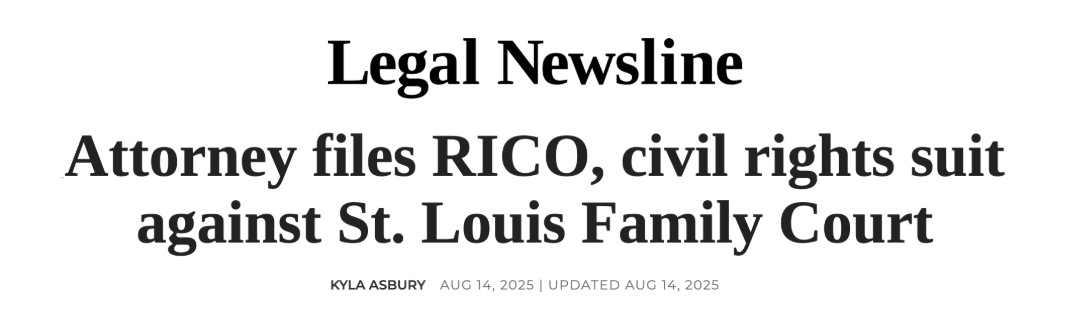
In 2024, Missouri attorney and father Matthew R. Grant filed a federal RICO and civil rights lawsuit in the U.S. District Court for the Eastern District of Missouri.
The suit accused St. Louis County Family Court judges, commissioners, attorneys, and guardians ad litem of running an organized criminal enterprise dubbed “Clayton Kids for Cash” that manipulates custody outcomes through extortion, wire fraud, obstruction of justice, and perjury.
Grant alleged the enterprise treats children as leverage to generate excessive guardian ad litem and legal fees and force unfair settlements. When he publicly exposed corruption, he claimed the system retaliated against him by reducing his prior equal shared custody of his two teenage sons from 15 nights a month to one overnight per week, with further cuts threatened if he refused to recant his claims.
Grant is currently seeking injunctive relief to reform court practices. He states that the case is not merely a custody dispute but an effort to dismantle a system that exploits families and children for profit.
Palmetto “Price Tag”
The two stories coming out of Missouri are deeply alarming. But what if they’re just outliers that don’t apply to South Carolina?
Unfortunately, documented evidence suggests the same mechanisms can be found in at least some Palmetto State Courtrooms.
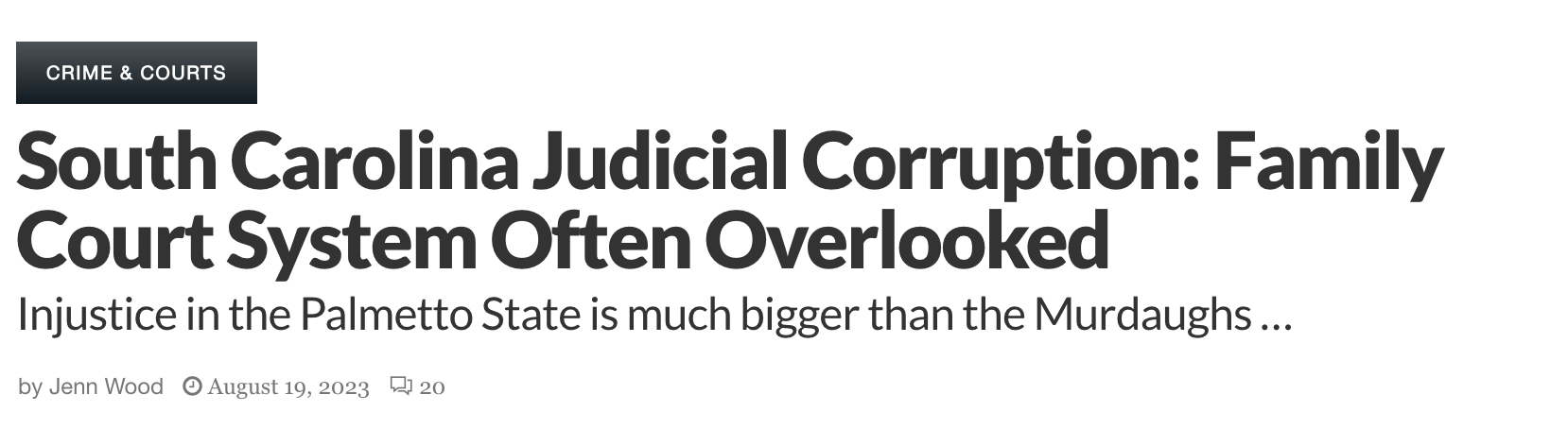
In 2023, FITS News reported the story of “Mother Doe” describing family court corruption in which her children were viewed as a financial commodity.
In a case spanning more than two years, Doe alleged a coordinated effort by multiple attorneys, along with a forensic psychologist and a guardian ad litem, to unjustly strip her of custody. Doe described the court actors colluding to make false accusations of instability and alcohol problems, and threatening retaliation if she fought back.
She documented the misconduct with nearly three dozen private recordings and filed a detailed 35-page complaint (backed by roughly 400 pages of evidence) with the Office of Disciplinary Counsel. Her legal costs exceeded $150,000 amid demands that she also cover the opposing side’s fees.
While presenting her full evidentiary record to FITS News, the mother described the system as one in which children carry a “price tag” and go to the highest bidder, with attorneys and court-appointed professionals operating freely because reports of misconduct risk being used against the complaining parent.
Every year, more evidence piles up that the financial incentives governing family court are driving appalling outcomes.
Even if these financial malincentives only corrupt 5% of cases, it should be treated as a five-alarm fire.
Gag orders and fear of retaliation mean that it’s impossible to know the full extent of corruption, but when children are being sold to the highest bidder, any amount is too much.
If you found the evidence in this article alarming, please learn about what you can do to fix the system at scfamilycourt.org
